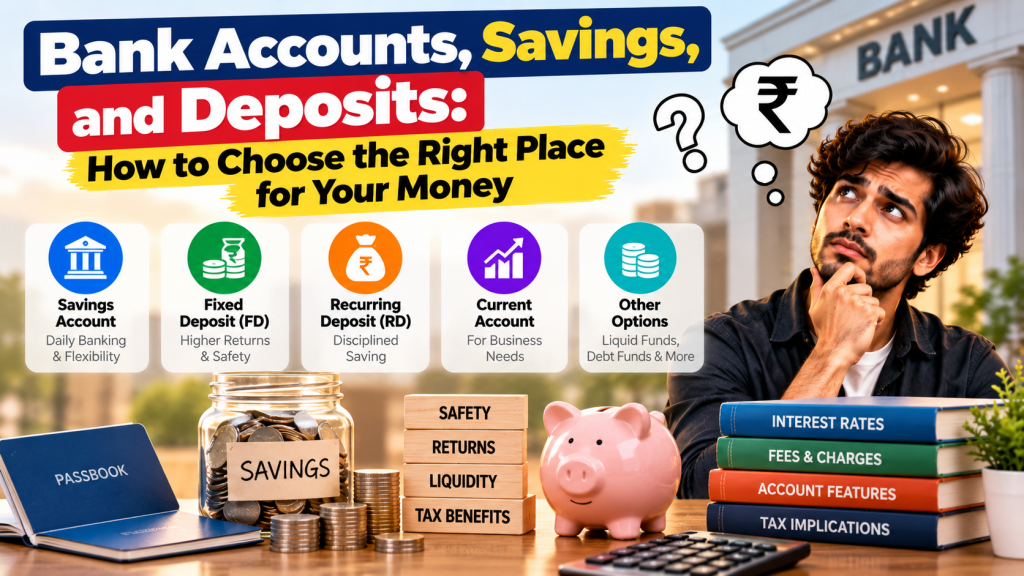
Bank Accounts, Savings, and Deposits: How to Choose the Right Place for Your Money
A beginner guide to savings accounts, fixed deposits, recurring deposits, liquidity, safety, and how banking fits into a personal financial plan.
Why the Type of Account Matters
Different bank products solve different problems. A savings account is designed for liquidity and regular transactions. A fixed deposit can be used for money that you want to keep relatively stable for a defined period. A recurring deposit can support disciplined monthly saving. Salary accounts and premium accounts may add conveniences, but the core question remains the same: what job should this money perform? Money for next month’s expenses should not be treated the same way as money for a five-year goal. Many people keep every rupee in one place, which makes budgeting and financial planning harder.
Separating daily spending, emergency reserves, and planned goals can make the system easier to manage.
Savings Account: Best for Liquidity
A savings account is useful for money you may need at short notice. It provides access through transfers, cards, UPI, cheques, and other banking channels depending on the account. The trade-off is that the return is generally not designed to maximize long-term growth. The account is therefore best thought of as a cash-management tool rather than a wealth-building product. Keep enough for regular bills, upcoming obligations, and a suitable emergency reserve. Avoid selecting an account only because of an attractive promotional benefit. Check minimum balance rules, service charges, ATM conditions, digital features, and customer support.
Convenience can be valuable, especially when the account handles your monthly cash flow.
Fixed Deposits: Useful for Defined Goals
A fixed deposit can be appropriate when you want predictable terms for money that you do not need immediately. The interest rate is generally fixed for the chosen tenure, subject to product terms and applicable rules. This predictability can be useful for short- or medium-term goals where preserving capital and knowing the maturity amount are more important than maximizing market returns. However, compare the pre-tax and post-tax outcome and check withdrawal or premature closure conditions. Do not automatically lock your entire emergency fund into a long deposit. Liquidity has value. A product that pays a little more but makes access difficult may be a poor fit for money that could be needed during an emergency.
Recurring Deposits and Saving Habits
Recurring deposits can help people who prefer a fixed monthly commitment. The psychological benefit can be as important as the interest rate because the product creates a routine. A recurring deposit can work for goals such as annual insurance premiums, planned purchases, or education-related expenses when the goal date is reasonably clear. The discipline of automatic saving reduces the temptation to spend everything that arrives in the account. Still, do not use a recurring deposit as a substitute for a broader emergency fund. You should also review the maturity date and what happens if a payment is missed.
Good financial systems should be simple enough to continue during busy months.
Compare More Than the Advertised Rate
Interest rate is important, but it is not the only comparison point. Look at tenure, minimum deposit or balance, premature withdrawal terms, tax treatment, payout frequency, nomination facilities, digital access, and customer service. For deposits, compare what you will actually receive after tax rather than using the headline number. For transaction accounts, consider charges that may reduce the practical value of a high promotional rate. It is also important to understand whether your money is within the applicable deposit insurance framework and what the relevant coverage rules are. Bank products should be evaluated for the role they play in your plan, not as isolated products.
Emergency Money Needs Special Treatment
An emergency fund is designed for uncertainty: medical expenses, job interruptions, urgent repairs, travel for family reasons, or other unexpected events. The most important feature is not the highest return. It is reliable access with low risk. A useful structure can be to keep a portion in a highly liquid bank account and, for people with suitable circumstances, place additional emergency reserves in other low-volatility and accessible products after understanding the conditions. The amount depends on your household costs and income stability. The general principle is simple: emergency money should not be invested in a way that can fall sharply at the same time you need it.
Banking and Digital Safety
As more transactions move online, account security becomes part of financial management. Use strong passwords, two-factor authentication where available, device locks, transaction alerts, and official banking applications. Never share one-time passwords, card PINs, or login credentials. Be cautious with links received through messages, calls that demand immediate action, and people claiming to be bank representatives. Review statements regularly and report suspicious transactions quickly. Digital convenience is valuable, but the customer must remain the first line of defense. A good bank account is not merely one with the right interest rate; it is one you can manage securely and understand.
Keep Your Banking Simple
Too many accounts can create confusion, unused balances, missed fees, and forgotten nominees. Many households can operate with a simple structure: one main transaction account, a dedicated emergency reserve, and specific deposits or savings products for defined goals. The best structure depends on income and obligations, but unnecessary complexity rarely improves financial health. Review accounts once or twice a year. Close dormant products where appropriate, update nominees, and maintain accurate contact details. Simplicity makes it easier to see where money is going and how much is available for investing or spending.
A Practical Bank-Selection Checklist
Before opening an account or deposit, compare the product’s purpose, access, rate, charges, customer support, digital experience, and applicable terms. For a deposit, calculate the maturity value and understand tax implications. For a savings account, examine balance rules and service fees. For all products, read the key terms instead of relying on advertisements. Think about what would happen if you needed the money tomorrow, in six months, or at the stated maturity date. The correct product is the one that aligns with the timing and risk needs of the money. Banking is the foundation of personal finance, so clarity here can make every later financial decision easier.
A Simple Comparison Checklist for Bank Products
When you compare bank products, write the choices in the same format so the marketing language does not distort the decision. Record the account or deposit purpose, amount, expected holding period, interest or return structure, liquidity, charges, taxation, and any penalties or conditions. Next, imagine two scenarios: you need the money earlier than planned, or you receive a large unexpected expense. Which option leaves you more flexible? Also check the practical side of banking. Can you operate the account easily from your phone? Are transaction alerts available? Is customer support accessible when you need it?
Can you add a nominee or update your details without unnecessary difficulty? A product that looks attractive on a rate table may become inconvenient when real life changes. Finally, avoid assuming that one bank must hold all of your money. A simple, purposeful structure can be safer for cash management than keeping everything in one undifferentiated account, while still avoiding unnecessary account clutter. The right question is not “Which bank gives the highest rate?” but “Which banking setup lets this money perform its intended job with acceptable risk and access?”