Google Pixel 11 Series Launched: Price, Features, AI, Camera, Battery and Everything You Need to Know
The smartphone market has received another major flagship launch, and this time Google is putting artificial intelligence at the center of the experience.
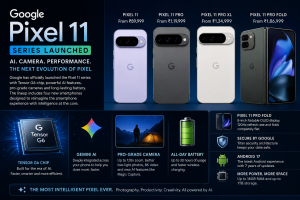
Google officially unveiled its Pixel 11 series on August 12, 2026, introducing four smartphones: the Pixel 11, Pixel 11 Pro, Pixel 11 Pro XL and Pixel 11 Pro Fold. The new lineup brings Google’s latest Tensor processor, updated camera hardware and software, deeper Gemini integration, new photography tools and additional AI-powered features.
The Pixel 11 series is especially important because Google is taking a different approach from many competing smartphone manufacturers. Instead of focusing only on raw processor performance, charging speed or megapixel counts, Google is making AI and software intelligence a central part of the phone.
The new phones also arrive at an interesting time for the smartphone industry. Samsung continues to compete strongly in the premium Android market, Apple remains the dominant premium smartphone brand in many countries, and Chinese manufacturers are competing aggressively through hardware, cameras, charging technology and pricing.
Google therefore needs the Pixel 11 series to offer something different.
Its answer is AI.
Pixel 11 Series Launch Date
Google unveiled the Pixel 11 lineup at its Made by Google 2026 event on August 12, 2026. The company introduced four smartphones at the event:
- Google Pixel 11
- Google Pixel 11 Pro
- Google Pixel 11 Pro XL
- Google Pixel 11 Pro Fold
Google also introduced the Pixel Watch 5 and other accessories at the same event.
The launch makes the Pixel 11 series one of the most important Android smartphone releases of August 2026.
Pixel 11 Price in India
Google has positioned the Pixel 11 series firmly in the premium smartphone category.
The reported Indian launch prices are:
| Model | Starting Price in India |
|---|---|
| Pixel 11 | ₹89,999 |
| Pixel 11 Pro | ₹1,19,999 |
| Pixel 11 Pro XL | ₹1,34,999 |
| Pixel 11 Pro Fold | ₹1,86,999 |
The Indian launch pricing was reported by The Economic Times following Google’s announcement.
The pricing means Google is not attempting to compete primarily with mid-range smartphones.
Instead, the company is targeting consumers who want a premium Android phone with Google’s software, camera processing and AI ecosystem.
Pixel 11: The Standard Flagship
The regular Pixel 11 is designed to provide much of Google’s flagship experience at a lower price than the Pro models.
It focuses heavily on:
- Google’s AI features
- Camera software
- Tensor processing
- Premium display technology
- Android software
- Security
- Long-term software support
The standard Pixel 11 is therefore likely to appeal to consumers who want Google’s latest smartphone technology without paying more than ₹1 lakh for the Pro models.
Tensor G6 Processor
One of the biggest technical changes in the Pixel 11 series is the introduction of the new Google Tensor G6 processor.
Google has continued to develop its own Tensor chips because the company wants hardware and software to work together closely.
The processor is particularly important for Google’s AI strategy.
Modern AI features can require significant processing power, especially when functions are performed directly on the phone rather than completely in the cloud.
According to reporting on the new Pixel lineup, the Tensor G6 offers improvements in performance and efficiency, while its AI processing capabilities are a major focus of the new devices.
This means the Tensor G6 is not simply about benchmark numbers.
Google is using the processor as the foundation for its AI-powered smartphone experience.
Why Google’s Tensor Chip Matters
Many flagship smartphones compete by using processors designed primarily around peak CPU and GPU performance.
Google has taken a different route.
Tensor is designed around Google’s broader ecosystem, including:
- AI
- Camera processing
- Speech recognition
- Translation
- Computational photography
- Security
- Voice assistance
This could make the Pixel 11 particularly attractive to people who use AI features regularly.
A user may not notice a faster benchmark score every day, but they may notice faster voice transcription, better photo processing, smarter search and more useful AI tools.
Gemini AI Is at the Center of Pixel 11
One of the biggest themes of the Pixel 11 launch is Google Gemini.
Google is increasingly integrating Gemini directly into its devices instead of treating AI as a separate application.
The Pixel 11 series uses Gemini-based intelligence for tasks involving:
- Search
- Translation
- Photography
- Voice interaction
- Productivity
- Personal assistance
- Contextual actions
Google’s broader strategy is to make the smartphone more proactive.
Instead of waiting for users to manually open an application and perform every action, the phone can increasingly understand what the user is trying to accomplish.
Magic Capture
One of the new AI-focused features introduced with the Pixel 11 lineup is Magic Capture.
The feature is designed to help users capture moments that might otherwise be missed.
The idea reflects an important direction in smartphone photography.
Traditionally, users have had to predict when something interesting is about to happen and press the shutter button.
AI-based systems can potentially make this process more intelligent by helping users capture useful frames automatically or by analyzing moments around the time of the photo.
This could be especially useful for:
- Children
- Pets
- Sports
- Events
- Travel
- Group photos
HiLight Feature
Google has also introduced HiLight, a new feature associated with the Pro models.
HiLight uses a visible light element to provide glanceable information and alerts.
The concept is different from conventional notification systems because the phone can communicate certain information visually without requiring the user to immediately unlock the display.
This is another example of Google’s attempt to make smartphone interaction more ambient and less dependent on opening applications.
AI-Powered Translation
The Pixel 11 series also expands Google’s use of AI for translation.
Google is pushing toward real-time translation across media and communication.
AI-powered translation can potentially help users:
- Understand foreign-language videos
- Communicate while traveling
- Translate speech
- Understand conversations
- Read foreign-language content
This is an area where Google’s large investment in AI and language models can provide a meaningful advantage.
Camera System
Camera performance remains one of the biggest reasons people buy premium Pixel phones.
Google has historically relied heavily on computational photography instead of competing only through larger camera sensors or higher megapixel counts.
The Pixel 11 series continues that strategy.
The new generation adds improvements to:
- Zoom
- Low-light photography
- Video stabilization
- Computational photography
- AI image editing
- Video processing
The Pro models receive the most advanced camera system.
According to reporting on the Pixel 11 Pro models, Google has introduced a redesigned 50MP main camera system, improved low-light capabilities, up to 120x zoom, a 42MP selfie camera and new video features.
Pixel 11 Camera: Why Software Matters
A smartphone camera is no longer determined only by hardware.
The final image depends on:
Sensor + lens + processor + software + AI
Google is especially strong in the software component.
Pixel phones use computational photography to combine multiple frames and improve:
- Dynamic range
- Skin tones
- Night photography
- HDR
- Detail
- Sharpening
- Noise reduction
This is why Pixel cameras can remain competitive even when competing phones advertise larger megapixel counts.
Improved Zoom
Zoom has become an important area of competition among premium smartphones.
Samsung, Apple, Xiaomi, Vivo, Oppo and other manufacturers are increasingly using multiple cameras and advanced AI processing to improve long-distance photography.
The Pixel 11 Pro models reportedly support up to 120x zoom, while the standard Pixel 11 offers up to around 30x Super Res Zoom depending on configuration and software features.
High digital zoom is not equivalent to true optical zoom at every magnification, but computational photography can make these extreme zoom modes considerably more useful than traditional digital zoom.
Better Low-Light Photography
Low-light photography is another area where Google’s AI approach becomes important.
Phones can capture several images and combine them computationally to improve brightness and detail.
The Pixel 11 Pro models add further improvements to Google’s low-light photography system, including new versions of Night Sight.
For users who frequently take photographs:
- At night
- Indoors
- At restaurants
- During concerts
- During travel
- In poorly lit streets
these improvements can make a significant difference.
Instant Night Sight
Google has introduced an Instant Night Sight feature for the Pro series.
The aim is to make nighttime photography faster while still providing computational improvements.
This is another example of Google’s focus on reducing the amount of manual adjustment required from the user.
The camera should ideally determine what processing is necessary automatically.
8K Video and Pro Stable Video
Video recording has also received attention.
The Pro models add advanced video tools including 8K Pro Stable Video.
This is particularly relevant for:
- Content creators
- YouTubers
- Short-video creators
- Travel vloggers
- Social-media users
Smartphones have increasingly replaced dedicated cameras for casual and even professional social content.
Better stabilization and higher-resolution recording therefore have significant practical value.
Creator Suite
Google has also expanded the Pixel’s creator-oriented software.
The new Creator Suite is designed to make it easier to shoot and edit content.
Modern smartphones are increasingly becoming complete content-production tools.
A creator can now:
- Record video.
- Edit the footage.
- Improve the image using AI.
- Add effects.
- Publish the result.
All from the same device.
This makes smartphone software increasingly important.
Display Technology
The Pixel 11 Pro models continue Google’s focus on premium displays.
According to published specifications and reports, the Pro models use high-refresh-rate OLED displays with improved brightness, while the Pro XL provides the larger screen option.
High refresh rates provide smoother:
- Scrolling
- Gaming
- Animations
- App transitions
- Web browsing
Higher brightness is particularly useful outdoors.
A bright display can make a major practical difference when using a phone under direct sunlight.
Pixel 11 Pro XL
The Pixel 11 Pro XL is designed for consumers who want the largest traditional Pixel flagship.
The major advantages of the XL model are:
- Larger display
- Larger battery
- Premium camera system
- High brightness
- Large storage options
- Pro-level AI features
The device is priced at ₹1,34,999 in India, placing it firmly in the ultra-premium Android market.
For users who watch a lot of video, play games or work from their phone, the larger screen can be particularly useful.
Pixel 11 Pro Fold
The Pixel 11 Pro Fold is perhaps the most interesting phone in the lineup.
It combines Google’s Pixel software and AI ecosystem with a large foldable display.
The new foldable reportedly has an 8-inch internal OLED Super Actua Flex display, a 120Hz refresh rate and a redesigned hinge that allows the phone to fold completely flat.
The device is aimed at consumers who want something more versatile than a conventional smartphone.
Why Foldable Phones Matter
A foldable smartphone can essentially provide two devices in one.
When closed, it works as a normal smartphone.
When opened, it provides a much larger display for:
- Multitasking
- Video
- Gaming
- Reading
- Documents
- Browsing
- Productivity
This makes the Pixel 11 Pro Fold particularly interesting for professionals and heavy smartphone users.
Pixel 11 Pro Fold and Productivity
A large internal display can be especially useful for multitasking.
For example, a user might:
- Keep email open on one side.
- Browse documents on another.
- Watch a video while taking notes.
- Use a large keyboard interface.
- Manage multiple applications simultaneously.
This is one reason foldable smartphones are increasingly being considered productivity devices rather than simply unusual smartphones.
Battery Life
Battery life remains one of the most important smartphone specifications.
Google says the new Pixel phones can provide up to 30 hours of battery life under its stated conditions, with faster wireless charging compared with previous models.
The exact battery experience will still depend heavily on:
- Screen brightness
- 5G usage
- Gaming
- Camera use
- GPS
- AI processing
- Background applications
Therefore, a manufacturer’s battery estimate should be viewed as a general benchmark rather than a guarantee for every user.
Faster Charging
Charging speed has become a major battleground in the smartphone industry.
Chinese smartphone makers increasingly offer extremely fast wired charging.
Google’s strategy remains more conservative.
The Pixel 11 series focuses on improving charging and wireless charging while maintaining Google’s broader emphasis on battery efficiency and software optimization.
For some buyers, however, charging speed could remain an area where the Pixel lineup trails certain competitors.
Storage Starts at 256GB
Another major change is storage.
The new Pixel lineup starts with 256GB storage, rather than the smaller base capacities common in some previous generations. The Pro models can reportedly reach up to 1TB of storage.
This is useful because smartphones increasingly store:
- 4K videos
- 8K videos
- RAW photos
- Games
- Offline movies
- AI-generated content
- Large applications
A higher starting capacity can therefore reduce the need to immediately purchase a higher-storage model.
RAM and Performance
The Pixel 11 series also increases the memory available to users.
Reports indicate that the standard models offer 12GB of RAM, while Pro models can reach 16GB.
Large amounts of RAM can help with:
- Multitasking
- Keeping applications open
- AI processing
- Photo editing
- Video editing
- Gaming
However, RAM capacity is only one part of performance.
The operating system, processor, memory speed and software optimization also matter.
Android 17
The Pixel 11 series arrives with Google’s newest Android generation.
Pixel devices are usually among the first phones to receive new Android features because Google controls both the operating system and the hardware.
This gives Pixel phones an advantage for users who want:
- New Android features
- Early security updates
- Google’s latest AI tools
- Long software support
Google continues to emphasize long-term software support as an important part of the Pixel experience.
Seven Years of Updates
Long-term software support has become one of the most important features of modern smartphones.
Google continues to offer extended update support for Pixel devices.
This can be particularly important for people who keep their phones for many years.
A phone that continues receiving security and operating-system updates can remain useful much longer than a device that stops receiving updates after only a few years.
Security
Google has also strengthened the security architecture of its Pixel phones.
Pixel devices use Google’s dedicated security technologies, including the Titan security architecture, designed to protect sensitive data and device operations.
Security features are especially important as smartphones increasingly contain:
- Banking applications
- Password managers
- Work documents
- Personal photographs
- Private messages
- Payment information
The smartphone has effectively become one of the most important personal computing devices.
Google Pixel 11 vs iPhone
The Pixel 11 series arrives shortly before Apple’s next-generation iPhone launches.
This creates an interesting competition.
Apple’s strongest advantages include:
- iOS ecosystem
- Apple silicon
- App ecosystem
- Video recording
- Hardware integration
- Long-term software support
- Global brand strength
Google’s strongest advantages include:
- Android
- Gemini AI
- Computational photography
- Google’s search ecosystem
- AI-powered editing
- Pixel-exclusive software
For consumers already invested in Apple’s ecosystem, switching to Pixel may be difficult.
For Android users, Pixel 11 provides one of the cleanest and most direct Android experiences available.
Pixel 11 vs Samsung
Samsung is arguably Google’s most important Android competitor.
Samsung has strengths in:
- AMOLED displays
- Hardware design
- Ultra-wide camera technology
- Zoom
- Productivity features
- Foldables
- Galaxy ecosystem
- High-speed charging in some models
Google counters with:
- AI integration
- Pixel photography
- Android software
- Gemini
- Google’s computational photography
- Long-term software support
The difference between the two companies is increasingly about software philosophy.
Samsung offers a large number of customization and hardware features.
Google focuses heavily on simplicity and AI.
Pixel 11 vs Chinese Flagship Phones
Chinese manufacturers such as Xiaomi, Vivo, Oppo and OnePlus are also major competitors.
These companies frequently compete with:
- Extremely fast charging
- Large batteries
- High-resolution cameras
- Premium displays
- Powerful chipsets
- Advanced cooling
- Competitive prices
Google’s strongest response is software and AI.
This is an important distinction.
A Chinese flagship may offer significantly faster charging, while Pixel may offer a more deeply integrated AI experience.
Consumers therefore need to decide which features actually matter to them.
Is Pixel 11 Worth Buying?
The Pixel 11 series is particularly attractive to people who prioritize software and AI.
It may be a strong choice for:
- Photography enthusiasts
- Android users
- AI users
- Content creators
- Google ecosystem users
- People who want long software support
- Users who prefer clean Android
- People who want strong computational photography
However, buyers who prioritize ultra-fast charging or the highest raw gaming performance may find stronger alternatives elsewhere.
Main Advantages of Pixel 11
Excellent AI Integration
Gemini is deeply integrated into the experience rather than being treated as a standalone application.
Strong Camera Processing
Google continues to use computational photography as a major competitive advantage.
New Tensor G6 Chip
The new processor gives Google a platform specifically optimized for its AI ecosystem.
Long Software Support
Pixel devices are designed for long-term software updates.
Strong Security
Google continues to emphasize device and data security.
Foldable Option
The Pixel 11 Pro Fold gives users a larger-screen alternative.
Possible Disadvantages
Premium Pricing
Starting at ₹89,999, the regular Pixel 11 is not an affordable smartphone.
Charging Speed
Some competing Android manufacturers offer considerably faster charging.
Limited Hardware Variety
Google still offers fewer smartphone models than many Chinese competitors.
Gaming
The Pixel experience is not necessarily aimed at extreme gaming enthusiasts who prioritize maximum sustained GPU performance.
Pro Model Pricing
The Pro XL and Fold models are expensive enough that buyers should compare them carefully with Samsung, Apple and other premium alternatives.
Pixel 11 Series: Main Specifications
| Feature | Pixel 11 | Pixel 11 Pro | Pixel 11 Pro XL | Pixel 11 Pro Fold |
|---|---|---|---|---|
| Processor | Tensor G6 | Tensor G6 | Tensor G6 | Tensor G6 |
| Display | Premium OLED | LTPO OLED | Large LTPO OLED | Foldable OLED |
| RAM | Up to 12GB | Up to 16GB | Up to 16GB | Up to 16GB |
| Base storage | 256GB | 256GB | 256GB | 512GB |
| Camera focus | AI photography | Pro triple camera | Pro triple camera | Triple camera |
| Zoom | Up to 30x | Up to 120x | Up to 120x | Advanced zoom |
| AI | Gemini | Gemini | Gemini | Gemini |
| Foldable | No | No | No | Yes |
| India starting price | ₹89,999 | ₹1,19,999 | ₹1,34,999 | ₹1,86,999 |
Specifications are based on Google’s launch information and current reporting; exact configurations can vary by market.
Why the Pixel 11 Launch Is Important
The Pixel 11 launch is significant because Google is attempting to redefine what a smartphone upgrade means.
In previous generations, upgrades were often about:
Faster chip + better camera + larger battery
Google is now trying to make the formula:
Better AI + smarter software + better camera intelligence + stronger personalization
This may represent the next major phase of smartphone competition.
Instead of asking only:
“How powerful is the processor?”
Consumers may increasingly ask:
“How useful is the AI?”
The Future of AI Smartphones
The Pixel 11 series shows where Google believes smartphones are heading.
The smartphone is becoming an AI interface.
In the future, users may interact less with individual applications and more with an intelligent assistant capable of performing tasks across multiple services.
For example, instead of opening a translation app, camera app and messaging app separately, a user could ask the phone to translate what is happening, summarize it and send the result to someone.
That type of interaction is exactly where Google believes its ecosystem can provide an advantage.
Final Verdict
The Google Pixel 11 series is one of the most important smartphone launches of August 2026.
Google has introduced four new devices, ranging from the ₹89,999 Pixel 11 to the ₹1,86,999 Pixel 11 Pro Fold in India.
The most important improvements are not simply cosmetic.
Google is putting major emphasis on:
Tensor G6 + Gemini AI + computational photography + improved video + long-term software support + foldable technology.
The Pro models take the camera system further with advanced zoom, improved low-light photography and professional video tools, while the Pixel 11 Pro Fold targets users who want a smartphone that can also function as a large-screen productivity device.
For photography and AI enthusiasts, the Pixel 11 series could be one of the strongest Android options available.
For users who prioritize extremely fast charging, maximum gaming performance or aggressive pricing, competing smartphones may provide better value.
Ultimately, Google’s biggest advantage is not one specification.
It is the combination of Android + Gemini + Tensor + Pixel camera processing + Google services.
That combination allows Google to control both the hardware and software experience.
And as artificial intelligence becomes increasingly important in smartphones, that integration could become much more valuable.
The smartphone industry is moving into a new era where the biggest battle may no longer be about megapixels or benchmark scores.
It may be about how intelligently a phone can understand, predict and assist its user.
The Pixel 11 series is Google’s strongest statement yet that AI will be at the center of that future.