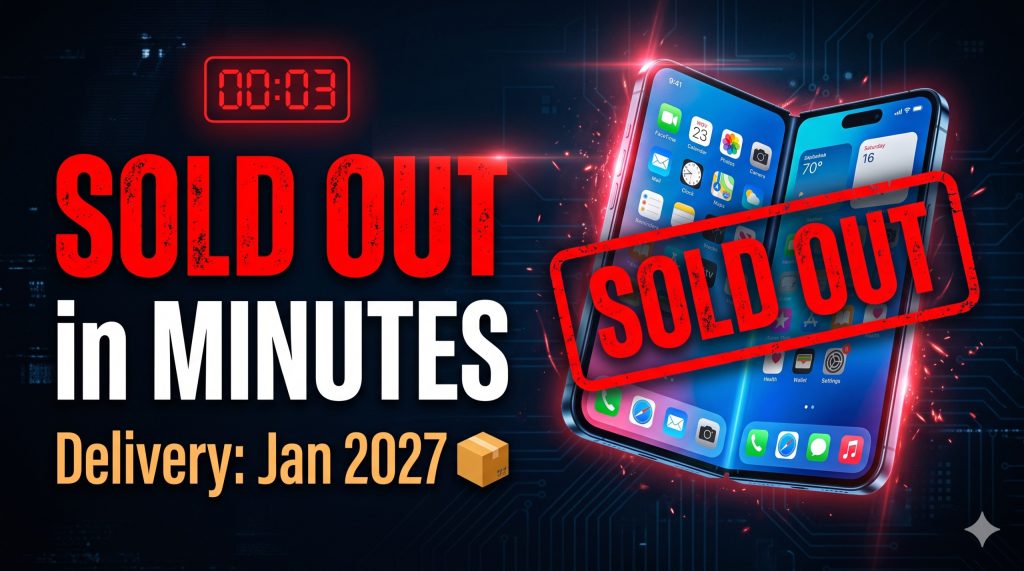
iPhone Duo Sells Out Within Minutes as Delivery Estimates Slip to January 2027
Apple’s ambitious leap into dual-display mobile hardware reached a critical milestone on October 18, 2026, when initial launch pre-order inventory for the newly announced iPhone Duo was exhausted within twelve minutes of opening. Across key retail territories including North America, Western Europe, Japan, and Singapore, prospective buyers checking out via digital storefronts watched projected delivery arrival windows slip instantly from late November launch dates well into January 2027.
The rapid depletion of launch units underscores intense consumer curiosity surrounding Apple’s proprietary dual-panel architecture. However, the multi-month dispatch lag also highlights substantial manufacturing bottlenecks associated with microscopic multi-axis hinge tolerances and specialized dual OLED panel calibration. For consumers and market watchers alike, this unprecedented inventory bottleneck transforms the iPhone Duo launch from a routine product release into a definitive case study in supply chain friction, advanced industrial engineering, and early-adopter market psychology.
Key Takeaways
- Immediate Stock Depletion: Global launch inventory for all base and high-tier configurations of the iPhone Duo depleted in under fifteen minutes on launch day.
- Extended Backlog: Primary retail channels now show fulfillment dates sliding directly into mid-January 2027 for new orders.
- Complex Component Architecture: The primary supply-side constraint stems from ultra-thin display panel integration and specialized mechanical hinge assembly lines operating under narrow tolerance bands.
- Software Ecosystem Readjustment: iOS DualCore system adaptations represent a major platform pivot, creating sharp demand from both enterprise developers and early-adopting power users.
- Consumer Options: Buyers facing extended waiting periods must evaluate carrier allocations versus official store queues while remaining vigilant against speculative grey-market reselling.
Context and the Evolution of the Dual-Screen Smartphone
The path toward a dual-screen device from Cupertino has been characterized by deliberate engineering delays rather than impulsive commercial iteration. While competitive mobile hardware manufacturers spent years experimenting with polymer-based single-folding screens, industry analysis repeatedly pointed out structural compromises: persistent panel creases, delicate protective coatings, and fragile mechanical hinges vulnerable to particulate ingress.
Rather than deploying a single flexible substrate prone to center-crease fatigue, the iPhone Duo incorporates two distinct, edge-to-edge micro-bezel displays linked by a concealed, geared kinematic hinge. This mechanical design prioritizes optical fidelity and surface rigidity, utilizing ion-exchange reinforced glass across both independent screens. By maintaining independent panels that join with minimal inter-display separation, the hardware architecture circumvents the structural vulnerabilities of flexible organic polymers, albeit at the cost of vastly increased manufacturing complexity and calibration overhead.
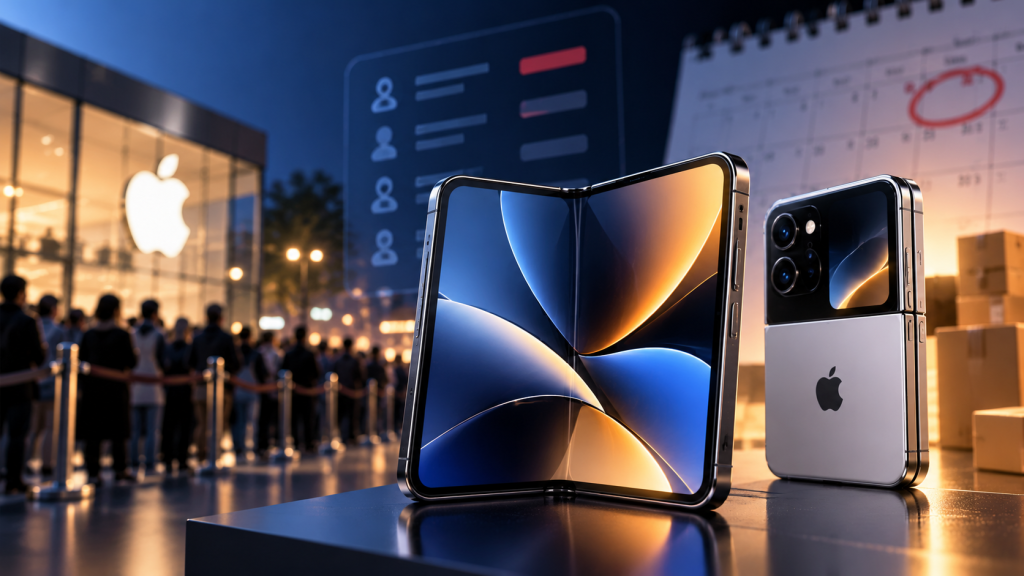
Why the iPhone Duo Supply Collapsed Under Early Demand
The swift migration of delivery dates into January 2027 results from an acute convergence between aggressive consumer demand and structural component yield challenges. Several specific technical friction points define this backlog:
1. Sub-Millimeter Panel Alignment and Micro-Bezel Yields
Unlike conventional slab-style mobile devices, the iPhone Duo requires simultaneous binning and optical grading of twin display assemblies. Each pair must share identical color temperature, gamma curve calibration, and luminance performance across all brightness tiers to prevent eye fatigue. Panel fabricators face strict optical tolerance bands; mismatched panels cannot simply be paired together without noticeable color shifts along the central margin, resulting in high rejection rates during initial assembly stages.
2. Kinematic Mechanical Hinge Machining
The articulated hinge mechanism comprises high-grade titanium-alloy micro-gears enclosed within a sealed chassis. Assembling these components requires micro-machining tolerances measured in single-digit microns to maintain resistance throughout a complete 360-degree rotation. Reports indicate that secondary assembly contractors have encountered lower-than-anticipated production throughput due to stringent quality control checks on friction torque and long-term wear resistance.
3. Thermal and Dual-Cell Battery Architecture
Balancing heat dissipation and weight across two separate enclosures necessitated a split motherboard and dual-battery architecture. Ensuring continuous power delivery and low-latency thermal balancing between both halves via high-speed flex interconnects introduces another layer of operational friction. Each completed unit must pass rigorous mechanical stress and continuous thermal validation before packaging.
Market Impact and Consumer Purchasing Realities
The emergence of a twelve-week fulfillment buffer creates tangible ramifications across the mobile consumer sector. Secondary marketplaces have already exhibited significant speculative price markups, with unauthorized scalpers listing confirmed launch-window delivery confirmations at steep premiums above the device’s retail price point.
Extended delivery delays for pioneer hardware categories often amplify perceived exclusivity, paradoxically accelerating consumer desire even while initial unit production volumes remain constrained by technical complexity.
Carriers and third-party telecom operators currently retain discrete logistical allocations separated from Apple’s primary direct-to-consumer online store. However, these subsidiary inventories typically involve long-term service agreements or trade-in contracts. Prospective buyers seeking unlocked devices with clear return windows face a protracted wait or must rely on spontaneous in-store pickup reservations as localized inventory adjustments occur.
Practical Guidance: Navigating the January 2027 Backlog
Consumers who did not secure a launch-week reservation can follow systematic steps to navigate the multi-month delay:
- Monitor Unclaimed In-Store Pickups: Retail storefronts frequently register canceled or uncollected launch-day pre-orders within forty-eight hours of physical release. Monitoring daily store inventory early in the morning can yield unexpected stock allocations.
- Assess Regional Carrier Inventories: Telecom network storefronts frequently receive dedicated inventory pools that deplete at different rates than unlocked consumer store inventories.
- Evaluate Software Maturity: An extended delivery date into January 2027 provides a practical advantage: early buyers will identify initial software bugs, thermal issues, and operational quirks in iOS DualCore, allowing developer patches to stabilize the platform before delayed orders arrive.
- Avoid Secondary Market Exploitation: Purchasing pre-order slots from secondary auction platforms carries substantial risk, including non-transferable invoices, restricted warranty coverage, and high financial markups that depreciate quickly as production stabilizes.
Frequently Asked Questions
Why did iPhone Duo delivery dates slip so quickly to January 2027?
The sudden change in fulfillment dates reflects a pairing of massive initial consumer pre-orders with low early assembly yields. Complex micro-bezel alignment requirements and strict manufacturing tolerances for the mechanical titanium hinge assembly have severely limited the volume of finished units available for the initial launch run.
Can shoppers still purchase an iPhone Duo in physical retail stores on launch day?
Apple typically reserves a small, highly limited allocation for walk-in retail purchases on official launch day. However, these walk-in units are distributed on a first-come, first-served basis and frequently sell out within hours of store openings, often requiring early-morning queueing.
Does the iPhone Duo use a single folding screen or two separate displays?
The device uses two discrete, high-resolution panels connected by a specialized mechanical hinge. This dual-display configuration provides a rigid glass writing and viewing surface without the central crease or soft protective coatings common in flexible polymer folding phones.
Are orders placed now locked into a January 2027 delivery timeframe?
While January 2027 represents the current conservative estimate, delivery dates occasionally advance if contract manufacturers resolve supply bottlenecks and increase weekly production output ahead of schedule. However, backward movement or further delays remain possible if key component yields fail to improve.
Conclusion
The immediate sell-out of the iPhone Duo and the subsequent push of delivery schedules into January 2027 highlight both the potent commercial pull of Apple’s latest form-factor experiment and the formidable engineering challenges of modern hardware manufacturing. As component yields stabilize and assembly lines adjust to the rigorous physical tolerances demanded by dual-display integration, early inventory shortages will eventually normalize. In the interim, consumers face a familiar dilemma in high-end consumer technology: navigating long delivery timelines, monitoring spot inventory replenishments, or exercising patience while the broader ecosystem matures.